
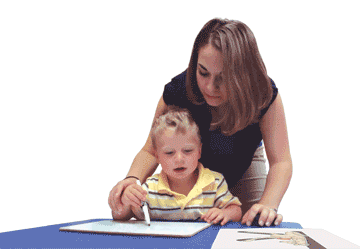
You will love using Zoo-phonics® at home with your child!
In order to serve you better, we’ve partnered with Wiz Kids for our home and family use programs. The link below will take you to their site to learn more about how you can start using Zoo-phonics® now to get your little reader off and running!
Start using Zoo-phonics® at home
Zoo-phonics® was born in a self-contained special education class!
We love Zoo-phonics®!!!!! In a little over a week, our boy, a 32-month-old with Down syndrome, learned all the signs and can now make almost all of the corresponding sounds. His speech therapist is elated and so are we! She says he is doing more and better work during speech therapy. He loves playing Zoo-phonics®Sean King Parent Seattle, WA June 16, 2015
Another amazing success story!
Hello to all at Zoo-phonics®! I want to write and thank you for a wonderful product. Our son Hunter (pictured) has many disabilities that make learning very difficult. He has been diagnosed with cerebral palsy, as well as Fetal Alcohol Syndrome, and a rare eye disorder. He was getting along socially, and is such aHelen Shupe Parent Wyoming, MI June 16, 2015
Now he is in Kindergarten and is reading at the 3rd grade level!
My son went to pre-school, when we lived in California. They were teaching Zoo-phonics there and he loved it! He caught on to it very quickly and basically taught himself how to read. Now he is in Kindergarten and is reading at the 3rd grade level!Amy Hickenlooper Parent March 10, 2016
Zoo-phonics is truly amazing!
Hanah and Sarah are 18 months old. As I was checking out of the grocery store, and holding Hanah, she looked at me and started saying “p”, “p”, “p” while moving from side to side in my arms. I looked around and found a giant penguin on the wall. She saw it and was tellingAngie Eberspacher Parent March 10, 2016
I am amazed at her progress in only FOUR SHORT MONTHS
I would like to thank everyone involved in making Zoo-phonics available for our children. I was questioning whether my child would ever grasp the concept of reading. She could identify only about eight letters. The concept that letters have sounds and sounds make up words was totally foreign to her. Then her teacher introduced Zoo-phonicsJustine de la Rosa Parent March 10, 2016
Wow! What a program!
I work as a Kindergarten Teacher for the Centralia School District which just adopted Zoo-phonics as an intervention system in order to familiarize myself with the program. I started introducing the letter sound cards to my 18-month-old son. (He started to notice letters when he was 12 months.) I just used the cards with himHeather Toller Parent and Teacher March 10, 2016
Thank you so much for this wonderful product! I believe it has changed our son’s life.
We love Zoo-phonics!!!!! In a little over a week, our boy, a 32-month-old with Down syndrome, learned all the signs and can now make almost all of the corresponding sounds. His speech therapist is elated and so are we! She says he is doing more and better work during speech therapy. He loves playing Zoo-phonicsSean King Parent March 10, 2016
It was nothing less than a miracle
I don't know what magic there is in Zoo-phonics...but the children did everything I had been struggling to get them to do. It was nothing less than a miracle.Janet Fodor Preschool, Special Ed. March 10, 2016
We have seen a dramatic improvement in all students who needed help learning the letter sounds, especially our ELL kids!
Since we integrated the Zoo-phonics program in our Kindergarten mid-year, we have seen a dramatic improvement in all students who needed help learning the letter sounds, especially our ELL kids! All of the students began learning the program together and this gave our ELL kids a lot of confidence as they made great progress alongLana Youngberg Teacher March 10, 2016
If I could take back children I had years and years ago, and teach them Zoo-phonics, I know they would have no problem with their reading and that's how I feel about it.Pat Hing Teacher March 10, 2016
By the end of the first month, we were building words!
Zoo-phonics brought the alphabet alive for my kindergarten students! After only one day, the students all could signal and say the sounds. By the end of the first month, we were building words! Zeke Zebra and all his friends really captivated the students! Great Program!Diane Kardash Kindergarten Teacher March 10, 2016
The enthusiasm of both the parents and the students has caused our students to make great progress.
Zoo-phonics is a great way to introduce children to sounds, letters and beginning reading. Connecting movement and animals to the sounds makes the learning fun and allows children to learn with their whole body. I have found that parents are not threatened by this program and readily join in the fun of moving and connectingSally Mathers Program Specialist March 10, 2016
Zoo-phonics is by far the most effective reading program that I have ever encountered in all my teaching years
I am a veteran teacher of 23 years. I have a masters degree in reading and have taught both general and special education. Zoo-phonics is by far the most effective reading program that I have ever encountered in all my teaching years. My special education kindergarten students learned all of their letter sounds in 2Pat Haberlein Teacher March 10, 2016
They are confidently sounding out and spelling CVC words as they write simple sentences
I have been teaching kindergarten for 5 years now. This year at the end of the 2nd trimester, all but one of my 20 students have a firm knowledge of letter recognition (upper and lowercase) and letter sounds. They are confidently sounding out and spelling CVC words as they write simple sentences. Their parents areShelley R. Collett Kindergarten Teacher March 10, 2016
This is a well-crafted Language Arts program that works for all children
Zoo-phonics, with its cast of child-pleasing Animal Characters, has made a dramatic impact on the beginning reading program at our school. Three, four, and five-year old students are sounding letters, blending letters, building words and reading. It is delightful to see and hear the students as they internalize the sound letter relationship in a natural,Nancy Newsome Principal March 10, 2016
Your use of picture mnemonics to teach letter-sound relations is indeed supported by findings of our 1983 study published in the Journal of Educational Psychology
Your use of picture mnemonics to teach letter-sound relations is indeed supported by findings of our 1983 study published in the Journal of Educational Psychology. In this study we found in two experiments that beginning readers learned letter-sound relations more effectively when they were taught associations between objects having shapes that resembled the shapes ofProfessor Linnea C. Ehri Program in Educational Psychology March 10, 2016
Students and parents LOVE Zoo-phonics!
"Students and Parents LOVE Zoo-phonics! My kindergartners adored their zoo animal friends, and they especially enjoyed singing “Come Meet Us At The Zoo” each morning shortly after arriving at school. But most rewarding to me as their teacher was meeting around the table with my smaller reading groups and noticing a child using the animal alphabetKelly Witmer, retired elementary school teacher, Achiever Christian School May 31, 2018
Ever since, I have considered Zoo-phonics to be the greatest tool in my teacher’s tool box!
Our private elementary school located in Silicon Valley was about a 20 minute drive from a large country club community that boasted an excellent, well-funded neighborhood public school. Over a period of a few years, we noticed a trend: many families from the country club area utilized our Pre-school and Kindergarten, and then would transferKelly Witmer, retired elementary school teacher, Achiever Christian School May 31, 2018
Zoo-kids and now Zoo-grand kids!
I am a retired school social worker and just placed an order to re-order a Parent Kit as a grandparent. I raised my 3 children in Calaveras County, and a few of their teachers introduced me to Zoo-phonics back in the late 80's. I ran a small home preschool, and all 6 of our studentsHeather O'Brophy, retired school social worker & at home preschool owner August 31, 2018
By the end of fourth grade, I was reading at a fifth grade level; just like magic.
My name is Lori McPherson and I am a mother of two littles in Rancho Murieta, California. First I want to take a moment to say truly, thank you. In 1992 I was eight years old and entering a new school because I could not keep up at the private catholic school that I hadLori McPherson, mom and early-educator-to-be April 10, 2019